Structure of the courses B
Basic Course B: 3 - 4 day course
(18 - 24 hours)
Course Objectives
1. Review of Course A knowledge
- Review the fundamental principles of developmental kinesiology and their relationship to pathology of the locomotor system static and dynamic undifferentiated positions
2. Extension of developmental knowledge
- Introduce more advanced developmental concept, particularly the differentiated global movement patterns – ipsilateral and contralateral.
- Determine kinesiological content and movement quality in within the global movement patterns in development.
3. Stabilization assessment and treatment in undifferentiated positions
- Review DNS tests and treatment positions from Course A
- Perform assessment of sagittal stabilization patterns and apply therapeutic strategies for recognized dysfunction in locomotor system.
4. Advanced postural analysis and functional testing
- Learn additional advanced functional tests for differentiated global movement patterns.
- Practice hands-on application with visual and palpatory control.
5. Corrective exercise progression
- Integrate corrective exercises based on DNS functional testing.
- Train exercises in differentiated ipsilateral and contralateral static positions, transitions between positions, and with use of unstable surfaces.
- Increase difficulty through resistance against “planned movement” and training of isolated segmental movements.
6. Clinical reasoning
- Develop advanced clinical reasoning to apply DNS protocols in everyday practice.
- Integrate DNS with patient education.
7. Practical DNS applications across populations
- Apply DNS principles in:
- infants and children (including DNS FIT Kid concepts),
- athletes (threshold training, performance optimization),
- neurological patients (SCI, stroke, spasticity, coordination),
- pregnancy (changes in load, stabilization, diaphragm and pelvic floor function),
- seniors (specificity of aging).
8. Progression in DNS education
- Prepare participants for the next level of DNS training – Course C.
Course goals:
- Master the logic of differentiated developmental movement patterns
Learn to recognize and clinically apply IPSI- and CONTRA-lateral patterns as the foundation of gait, rolling, and locomotion. - Be able to assess differentiated function of the trunk and limbs
Gain confidence in DNS testing involving rotation, weight transfer, phasic movements, and the quality of support in complex positions. - Understand how supportive and phasic limb function influences stabilization
Know when a joint functions as a punctum fixum and how to modify this in therapy. - Be able to precisely select therapeutic positions based on identified dysfunction
Apply developmental positions (side-lying, oblique sitting, crawling, tripod, differentiated bear), as targeted therapeutic tools. - Practically master facilitation, isolated and global movements, and progression
Establish proper support, control intra-abdominal pressure, work with functional joint centration, guide movement through stable segments, and transfer acquired skills into patients’ daily lives as well as into athletic performance.
Course Program Overview:
Day 1:
Registration:
1.block: Ontogenesis – review with emphasis on differentiated movement patterns.
Break
2. block: Review of assessment and therapy in undifferentiated positions (diaphragm test, upper limb elevation test, intra-abdominal pressure control in supine).
Lunch
3.block: Testing in differentiated movement patterns (rolling patterns, differentiated quadruped position, crawling, differentiated bear position).
Break
4.block: Patient demonstrations – live or video-based, including analysis.
Day 2:
1.block: Review of assessment and therapy in undifferentiated positions (intra-abdominal pressure control in sitting, quadruped position, modifications in low kneeling, bear, squat).
Break
2.block: Therapy in differentiated positions – workshop: side-lying, oblique sitting.
Lunch
3.block: Therapy in differentiated positions – workshop: crawling.
Break
4.block: Therapy in differentiated positions – workshop: differentiated bear position. Group exercise in developmental positions.
Day 3:
1.block: Application of DNS principles across different populations (infants and children, women during pregnancy and postpartum, application in sports, and in the elderly population).
Break
2.block: Workshop: Test – Therapy – Retest (differentiated and undifferentiated models)
Lunch
3.block: Summary of therapy principles, guiding patients toward self-therapy. Discussion, Q&A
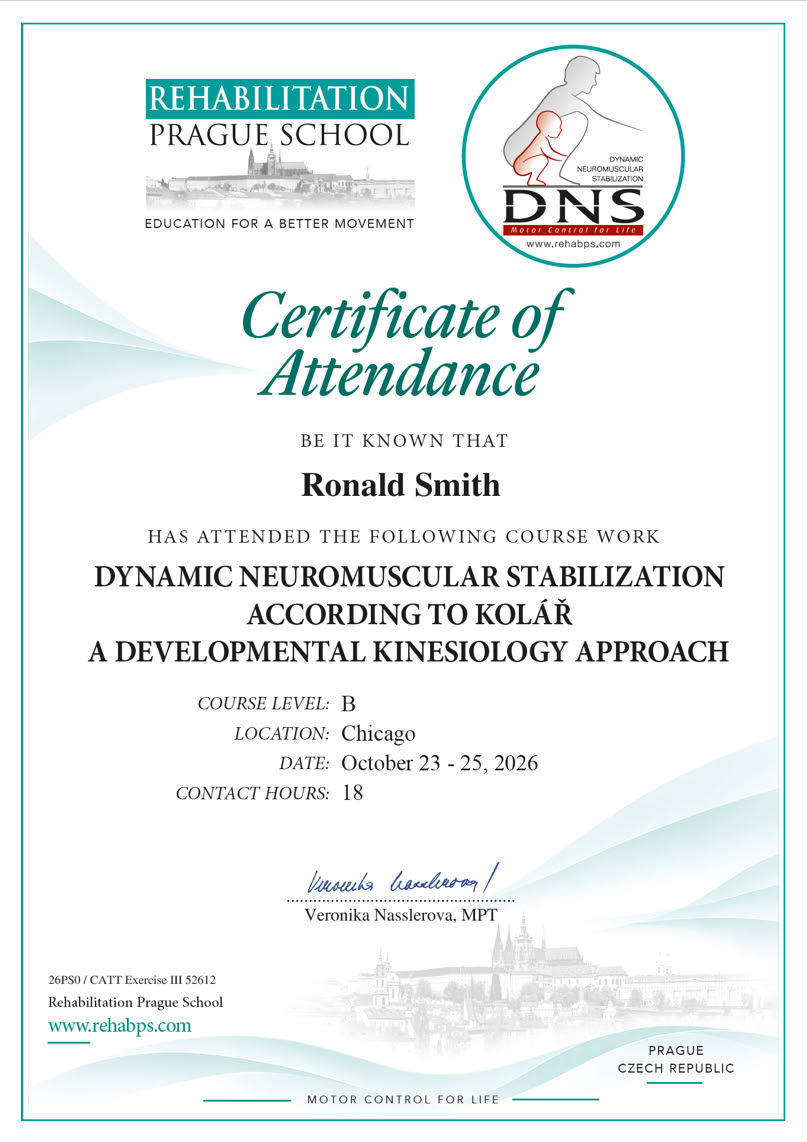
A Certificate of ATTENDANCE will be awarded by local instructor
OPTIONAL EXAMINATION
Participants who would like to participate in the educational track towards becoming a certified practitioner can take this exam for an additional fee of 150 Euros.
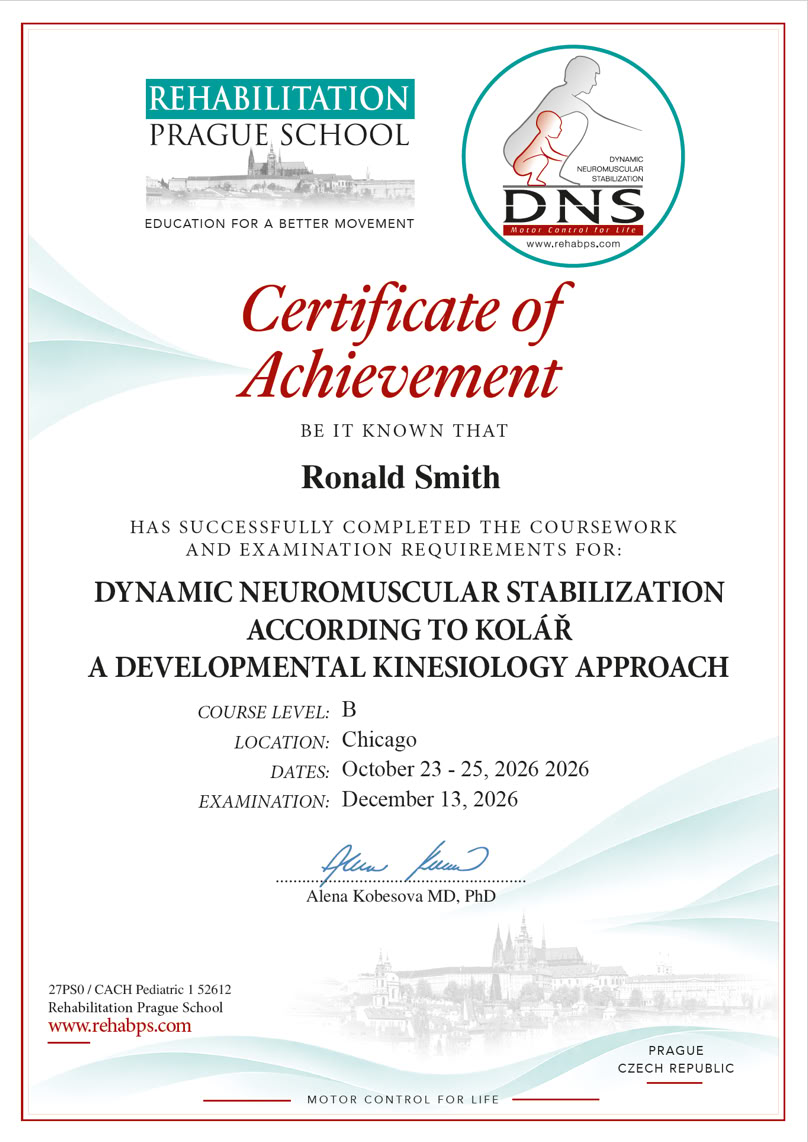
The test will consist of an analysis of babies at various developmental stages . Web link to view videos will be mailed to participant for analysis. Participants are advised to return the test to the DNS instructor within 2 months after the course. Upon successful completion and passing of the test, a Certificate of ACHIEVEMENT from Prague School of Rehabilitation will be awarded.
May only re-take the test 3 times.
Otherwise, the clinician would be required to repeat one or more courses before re-qualifying for certification testing.